

Rooted Finds 002: Kitchen Confidante
LAYERS OF LOVE
One borrowed recipe, an engineer’s eye, and the many hands behind a slice of kek lapis.
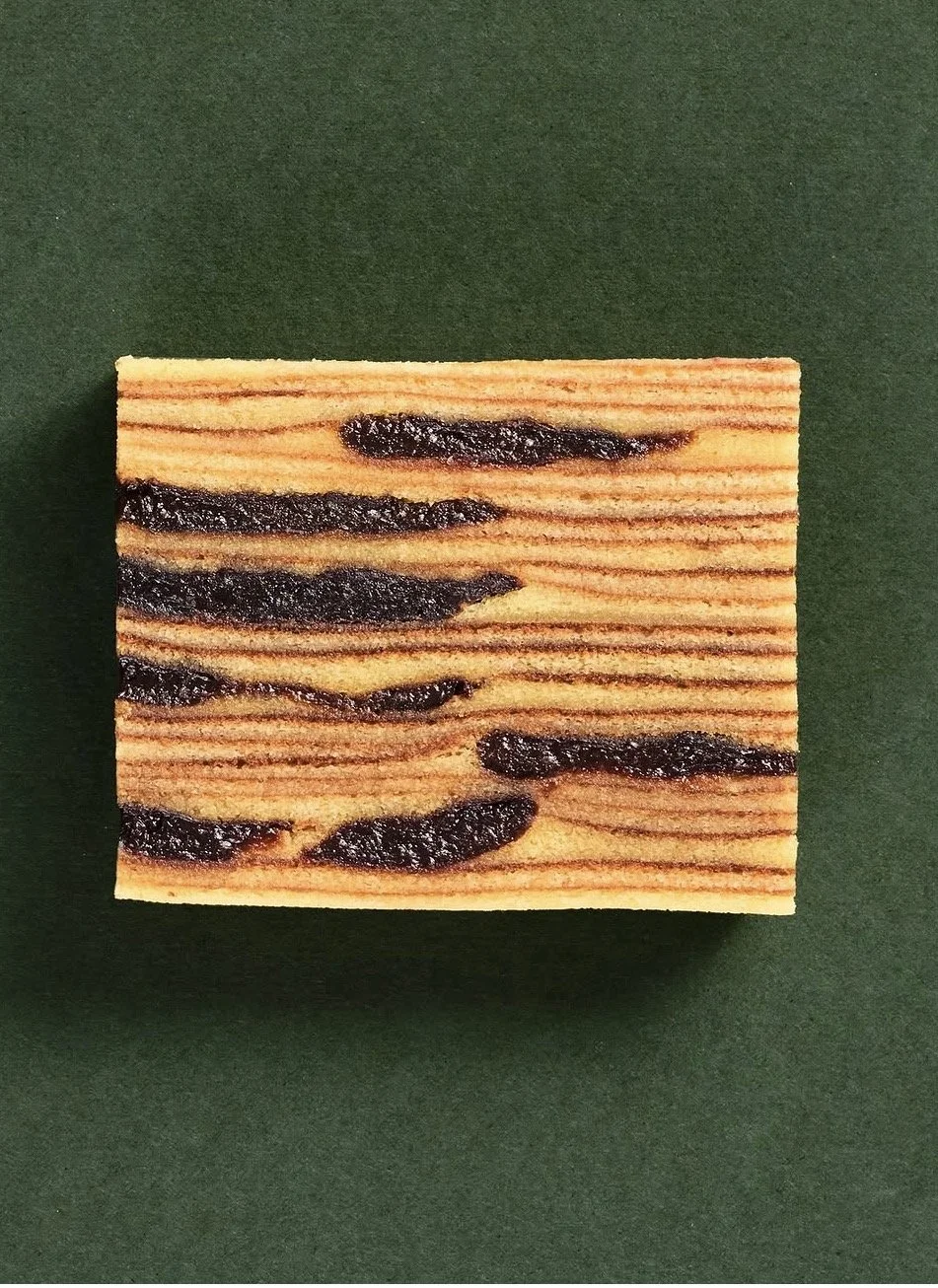
The first thing you notice about kek lapis is its pattern.
Cut into one and the cake changes completely. What looked almost restrained from the outside opens into diamonds, prisms, florals and repeating lines, all tucked neatly inside a single slice.
There is something almost jewel-like about that first reveal. The sort of thing that makes everyone at the table lean in a little closer before anyone remembers to eat it.
Of course, kek lapis is hardly unfamiliar to Malaysians. We know it from festive tables, open houses and the boxes carried home from Sarawak, sometimes with the ‘unsaid instruction’ to cut it thinly because “this one was expensive”.
Traditionally served during festive and special occasions, kek lapis Sarawak has become one of the state’s most recognisable foods.
So the surprise with Kitchen Confidante is not that Karen Chai has introduced us to something we have never seen before. It is that she makes us look twice at something we thought we already knew and already found fascinating to begin with.
And once you start looking, the pattern is only the beginning.
Kitchen Confidante’s founder, Karen Chai, was born and raised in Kuching, where baking was already part of life at home. Her mother, Jennifer, baked kek lapis, and Karen grew up watching and helping her in the kitchen.
But the recipe Karen inherited was not quite a family recipe in the neat, generational sense we tend to imagine. It originally belonged to the late mother of one of Jennifer’s friends.
The friend missed the cake her mother used to make and asked Jennifer whether she could recreate it from the recipe. Jennifer tried it. The friend loved the result enough to become Jennifer’s first kek lapis customer, later helping spread the word about her baking within their community.
Before Kitchen Confidante, then, there was simply a woman missing her mother’s cake and a friend willing to try making it for her. It was an ordinary beginning for something that would eventually become so visually extraordinary.
Recipes rarely travel as cleanly as we like.
Years pass, the recipe ends up somewhere nobody involved at the beginning could possibly have predicted.
By the time it reached Karen, this one had already passed through several hands.
What she did with it next is where things become particularly interesting.
Karen did not begin her professional life as a pastry chef.
She studied engineering at Universiti Teknologi Malaysia and worked as an engineer before eventually moving into the food industry.
Now you might wonder: what does engineering have to do with any of this?
It would be easy to treat her degree as an interesting biographical footnote.
Then you look at her cakes.
These patterns are not drawn onto the surface after everything else is finished.
They have to be built from inside.
Karen plans her more intricate kek lapis before baking them. Layers are grilled, cut into sections, sometimes sliced diagonally, turned, repositioned and assembled again so that the intended design emerges only when the completed cake is finally cut through. The baker is not designing the cake you see while she is making it.
She is designing the slice you will eventually see when it is cut.
At some point, the language stops sounding entirely like baking. There are
angles, sections, measurements, proportions, symmetry, reassembly
The cake starts to feel as though it belongs somewhere between a pastry kitchen and a drafting table. And suddenly Karen being an engineer does not feel incidental at all.
More time can be spent thinking through and planning a design than actually baking it. Some of Kitchen Confidante’s more elaborate geometric cakes take close to 12 hours to complete. Twelve hours for a pattern that does not fully exist until the knife goes through.
There is something wonderfully backwards about the whole exercise.
Karen has to see the slice before the slice exists.
A cut made hours earlier determines a line that appears much later. A piece that looks strange in isolation has to make sense beside another piece that may not even have been assembled yet. Everything is being built towards a cross-section.
Perhaps that is the engineer’s instinct hiding inside the baker’s hands: start with what you want the final thing to do, then work backwards until every component knows where it needs to be.
Karen did not build Kitchen Confidante alone either.
In 2019, she met Mak Kah Kein, her partner, and the two decided to work together. Kah Kein had recently left a long career in the sportfishing equipment industry and was exploring what to do next when Karen invited him into the business. Then the pandemic arrived and, like it did for so many small businesses, altered their plans.
Karen had previously moved between Kuala Lumpur and Kuching, often returning home during festive seasons to bake. Travel restrictions grounded the pair in Petaling Jaya, where they began developing Kitchen Confidante into the business it is today. And its current setup is perhaps our favourite detail about the whole operation.
Kitchen Confidante runs from a double-storey terrace house in Petaling Jaya. The entire ground floor has been turned into their baking workspace. There is something strangely fitting about that.
This whole story begins with baking that happened in a home.
Years later, after an engineering degree, another career, culinary training, a move across the country and a business built together with someone new, the cakes are still being made inside one. Only now the kitchen has taken over an entire floor.
Kitchen Confidante is quite literally built into the life Karen and Kah Kein share.
The recipe has changed along the way too.
Karen and the Kitchen Confidante team have adjusted ingredients, timing and techniques over the years to arrive at the flavour and texture they prefer. The designs became more complex; the presentation more contemporary. Their flavour combinations have included less conventional variations such as Fig & Apricot, Cempedak and Lemon Poppy Seed alongside traditional styles.
This is where the word traditional starts becoming interesting.
Because what, exactly, are we asking Karen to preserve?
The recipe her mother made? The recipe her mother’s friend remembered?
The colours? The flavours? The construction?
The answer becomes less obvious the closer you look.
But even kek lapis Sarawak itself has a history shaped by adaptation.
The Sarawak Tourism Board traces the arrival of the layered-cake tradition to the Betawi people from Batavia, present-day Jakarta, who brought Kek Lapis Betawi to Sarawak during the 1970s and 1980s. The earlier cakes were associated with warm spices such as cinnamon, cardamom, clove and star anise.
Sarawakian bakers subsequently took the form in a different direction.
Western cake-making influences and new flavour combinations entered the mix. Colours became brighter. Designs became increasingly elaborate. Patterned versions required the baked layers to be cut into strips or sections and rearranged to create the extraordinary cross-sections for which Sarawak’s kek lapis eventually became known.
Which means the geometry that seems so strikingly modern in Karen’s work also belongs to a much longer history of experimentation.
Kitchen Confidante DID NOT invent the idea of cutting and rearranging kek lapis. What Karen did was PUSH THAT LOGIC FURTHER.
More precise. More architectural. Sometimes almost kaleidoscopic.
Her engineering background gives her another vocabulary with which to approach something generations of bakers were already constructing by instinct and experience.
The result does not feel like old cake dressed up to look new.
It feels more like Karen has noticed something that was already hiding inside kek lapis all along:
it is an extraordinarily engineered cake.
That is why Kitchen Confidante caught our attention.
Not just because it tastes good and looks good, and not because it “reinvents tradition.”
We have become a little suspicious of that phrase. We wonder about the specificity of events behind how Kitchen Confidante came to be.
A recipe belonging to one woman’s late mother was given to her friend Jennifer because she missed the way the cake tasted. Jennifer learnt to make it. Her daughter Karen helped her in the kitchen. Karen grew up, became an engineer, left engineering, entered the food industry, studied pastry and eventually returned to kek lapis with an entirely different set of eyes. A recipe remembered by one family.
The hands of another mother.
An engineer’s diagrams.
A pastry chef’s palate.
Hours of work disappearing into a cake that, from the outside, still does not tell you very much. Until somebody slices it.
That is the strange magic of kek lapis. So much of the work is hidden by design.
The mistakes that presumably had to happen before anyone figured out the right ones.
The hands that came before.
You see none of that when the cake is whole.
You only see the result when someone finally cuts through all those layers and exposes what has been constructed inside.
So, yes, the first thing you notice is the pattern.
But by the end, you realise the real story behind how every layer was built.