

Rooted Finds 001: Pick A Pickle
What started as a jar of radish turned out to carry far more family history than we expected.
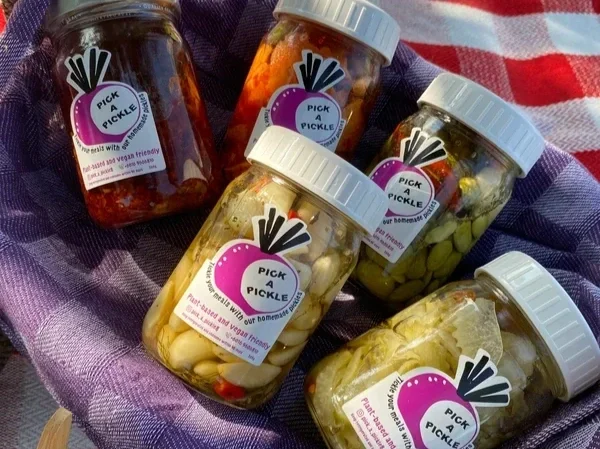
We first heard about Pick A Pickle at Kiwanis Kartnival Emas. At first, it was the name that we found intriguing: “Pick A Pickle?” Then came the jars of various pickles: radish, celery, petai, kedondong, sambal, mala sengkuang. It was a little unexpected, playful and very easy to remember. We tried their pickles and instantly knew there was something special behind it. So naturally, we went home and looked them up further.
Behind Pick A Pickle is Allan Yeo, a retired medic who began the business in his late sixties together with his wife, Sally, and their daughter, Audrie.
But the story of the brand did not really begin in 2022, when Pick A Pickle officially launched. It began much earlier, with Allan’s mother. She came from Chaoshan, China, and pickling was part of the food Allan grew up with. Not “heritage food” in the way we tend to describe these things now. Just food. The kind that appears at the family table often enough that nobody thinks to ask when it started. There was no recipe card framed for posterity, just a mother who knew how to make pickles and a son who paid attention.
So much of what families pass down does not look important at the time. It looks like your mother doing something in the kitchen she has done a hundred times before. It looks like a certain jar always being in the fridge. It looks like instructions that are not really instructions at all.
“A bit more of this.”
“Enough of that.”
Then, years later, somebody realises that what looked ordinary was knowledge. Allan remembered.
The interesting thing is that Allan never built his professional life around food.
Food kept following him around.
Allan went into the field of medicine, where he worked as a medical assistant with Malaysia’s Ministry of Health before later moving into offshore medical work in oil and gas. His career took him to different parts of the country, including more remote parts of Pahang. And while reading about those years, we kept finding food tucked into the edges of the story. Allan has spoken about encountering different methods of preserving ingredients during his postings, including pickled rubber seed. Yes, rubber seed.
We were shocked by that too. It is exactly the sort of detail that makes our work at Rooted Finds all the more fun, because suddenly you are no longer researching one pickle brand. You are wondering who first looked at a rubber seed and decided it should go into brine. But it also says a lot about Allan. He noticed how people ate. He remembered what they did with ingredients. He picked things up along the way. Later, when work took him overseas, food appeared again. While stationed in the United Kingdom, he worked part-time in a Japanese restaurant. Not because he was leaving medicine. Not because a food business was waiting for him back home. He simply wanted to cook.
That is more convincing to us than calling someone “passionate about food”. A full working day followed by another shift in a restaurant because you want to learn tells the story well enough. For most of Allan’s life, cooking never needed to become anything. It just remained part of him.
Then, retirement came.
Retirement is one of those things that sounds straightforward until you imagine actually arriving there. After decades of work, people tell you that you finally get to rest. No more deadlines. No alarm clock. Which sounds excellent. But work does more than occupy hours. It gives shape to a week. For years, there are people to feed, bills to settle, places to be, things that cannot simply be left until tomorrow. Then the children grow up. They move out. Work ends. There are fewer people at the dinner table.
And suddenly there is a lot more tomorrow than there used to be.
Audrie, Allan’s daughter, has spoken about watching her parents slow down after retirement. Allan was cooking less because there simply were not as many people at home to cook for. The family had considered whether Allan and Sally might do something in F&B. A hawker business was one possibility. But liking to cook and wanting to spend retirement operating a stall every day are two very different propositions. So that idea did not really go anywhere. Then one day, the family was eating Allan’s radish pickle and someone suggested selling it.
This was about as complicated as the first business plan got:
“Eh, why don’t we sell this?”
We like that beginning. There was no grand unveiling. The product already existed. The family already ate it regularly. Someone simply looked at something that had been sitting on their table for years and wondered whether other people might want it too. Then the timing lined up. Audrie knew someone putting together a food market where a booth was available.
And so, the family decided to try its first pop-up. They made the pickles, packed the jars and showed up at the event. Just like that… they sold out. There were pre-orders. Then more markets. By June 2022, Pick A Pickle had become a proper business. Allan was already in his late sixties.
There is an easy way to write that part of the story:
“It is never too late.”
“Follow your dreams.”
“Age is just a number.”
but let’s talk a lil more about the daughter who saw the business before there was one
The more we read about Pick A Pickle, the more Audrie became part of the story too. Allan already had the recipe. What Audrie helped do was give it somewhere new to go.
There is a point when children grow up and begin seeing their parents differently. The dish Dad always makes is suddenly not just dinner. The way Mum does something without thinking is actually skill. Growing up around that kind of knowledge can make it almost invisible. Then one day you realise not everyone knows how. And family knowledge does not travel on its own.
Someone has to give the recipe a name, take it to a market, explain it to strangers, answer the orders and work out what comes next. The older generation carries one kind of knowledge; the younger generation often brings another.
Pick A Pickle sits somewhere between the two.
It also gave Allan, Sally and Audrie something new to build together after the usual parent-child roles had already shifted, through markets to prepare for, recipes to test, labels, orders, new ideas and, we imagine, the occasional disagreement about Instagram. What we found most touching was that Allan never had to reinvent himself for any of this to happen. He simply finally had the room, for something that had followed him most of his life: cooking, experimenting and everything he had picked up along the way. And perhaps that is why the story started feeling a little personal.
How many things do our own parents know that we have never properly asked about?
“Who taught Mum that recipe?” “Why does Dad always buy that particular fish?” “Where did Grandma learn to make her sambal?”
Nobody announces these things as family knowledge. Because the person has always been there, we assume the knowledge will be too. Until it isn’t. Allan remembered what his mother taught him. He kept making it. Audrie noticed. And now strangers are eating it too. A piece of family knowledge escaped the usual fate of living and disappearing inside one household. What interests us more is how long the pieces of the story had already been sitting there. The recipe from his mother. All the things Allan had tasted and learnt over the years. The Japanese kitchen. The experiments at home. His family’s appetite. His daughter’s eye for what might work outside the family.
Pick A Pickle did not appear from nowhere after retirement. Retirement simply gave all those pieces somewhere to meet.
The OG before the OG
The radish pickle became the OG Radish. Which might be one of our favourite little generational collisions in the whole story. Here is a recipe that reaches back to Allan’s mother, repackaged under a name that sounds like it should be printed on a streetwear T-shirt. Allan himself apparently had to learn what “OG” meant.
Perfect.
Because the product really is an original, just not in the way the name first suggests. The technique came from one generation. Allan adapted it for his own family. Audrie’s generation helped give it a new name, a new presentation and a place in a modern market. There are at least three eras sitting inside one jar.
And the more we thought about that, the less interested we became in the idea that tradition is about keeping things unchanged. Family recipes do not survive just like that. They survive because people keep cooking them. Your mother uses less sugar than your grandmother did. You add chilli. Someone cannot find the same ingredient after moving away, so they substitute something else. Tastes shift. New flavours arrive. The dish changes. But the thread ultimately does not disappear.
That may be a better form of preservation than trying to keep everything exactly as it was.
Then came the celery pickle
The celery pickle might be the best example of how Allan actually cooks. His wife Sally would sometimes have celery left over after making dinner. There was too much to throw away and apparently too much to keep serving to the family in its original form without creating some level of domestic resistance. So Allan started experimenting. He pickled it and after a few attempts, it worked well enough to become a product. Some customers who did not even particularly like celery ended up liking the pickle.
It is such a small story, but it tells you almost everything you need to know. There was no meeting where somebody identified a gap in the premium celery condiment category. There was simply extra celery and a family who did not want to waste it. And so, Allan did something with it.
This logic feels instantly familiar in a Malaysian household.
“Sayang lah.”
“Do not throw first. Tomorrow can eat.”
“See what else we can make.”
Before sustainability had its own vocabulary, many Asian families were already doing this every day. Rice became another meal. Fruit was salted or preserved before it spoiled. Vegetables were fermented, pickled, dried or cooked down. Things lasted because people needed them to last. Pickling came from practicality long before anyone put it in an artisanal jar. The celery pickle is not just a great product story because it sounds innovative. It is a great product story because it sounds like home.
Then there was petai, kedondong, mala sengkuang, sambals, salted radish.
The products began crossing all sorts of culinary lines. And that might be where Pick A Pickle starts feeling most Malaysian. The brand began with a recipe tied to Allan’s Teochew background, but it does not spend all its time trying to prove how traditional it is. The range wanders. Flavours from different places meet. Ingredients that did not begin in the same food culture end up sharing shelf space. Which is not very common, but neither is Malaysian eating.
Our food histories overlap constantly. Recipes arrive with grandparents and change here. People learn from neighbours. Someone marries into another family. A child grows up somewhere different from their parents. A new ingredient becomes popular and suddenly turns up everywhere. At some point, the question “where exactly did this come from?” becomes harder to answer than “does it taste good?”
Pick A Pickle is an illustration of just that. There are roots, yes. But they do not behave like boundaries.
“Preservation changes things”
The metaphor is sitting right there, so we may as well use it. Pickling preserves food. But it does not do so by keeping the ingredient exactly the same. A pickle is changed by the process. It becomes sharper, sweeter, more sour, saltier. Time works on it. And because it changes, it lasts.
The same is true of the story behind Pick A Pickle. Allan’s version is not exactly his mother’s. The brand is not exactly what Allan would have built alone. The products now move well beyond that first radish. Things were altered along the way. That is not evidence that the original was lost. It is evidence that somebody kept using it.
Tradition that cannot move eventually becomes display.
Tradition that people keep touching has a chance to stay alive.
So what did we actually find?
We found Pick A Pickle at Kiwanis Kartnival Emas.
Then we found a retired medic.
A mother from another generation whose recipe was still travelling.
A wife with too much celery.
A daughter who understood that what her parents knew might matter outside their home.
A family business that became a way to keep making things together. And a shelf of jars that, the longer we looked at them, seemed to contain much more than vegetables.
That is what we want Rooted Finds to be about. Not simply things that are local. Not things that can be labelled “heritage” and left there. We write about the things that make us look again. The ones where the first story turns out not to be the whole story. The things sitting right in front of us with histories that have not been loudly announced.
The story had already been travelling for years.
We’re just glad we happened to find it.